





Tag: character at camp
Around the Table: How Shared Meals Strengthen Our Camp Community
At camp, when we gather for meal time, something magical unfolds: bonds deepen, laughter flows, and a sense of belonging grows.
Why Shared Meals Matter
Recent research confirms what so many of us have felt — sharing meals is a powerful way to build connection, belonging, and well-being. According to the 2025 World Happiness Report (WHR), people who dine with others frequently report significantly higher life satisfaction, more positive emotions, and less negative affect — across ages, cultures, and countries (6).
Eating together doesn’t just feed our bodies — it nurtures our social bonds. Numerous studies describe communal dining (sometimes called commensality) as a key ritual for forging and reinforcing trust, friendship, and sense of belonging (3).
Moreover, communal meals offer more than emotional benefits. For children and teens, regularly eating family-style meals — where everyone sits and eats together — is linked to better mental health, healthier eating habits, reduced risky behaviors, and even improved academic performance (1).
How This Aligns with Our Farm Camp Philosophy
When we look at our history and philosophy, we’re reminded that our camp was founded not just as a place to play and learn, but as a place to belong. On our “About” page, we talk about the importance of community, connection, and living in rhythm with the land, the animals and each other.
Our family-style breakfasts and dinners reflect those values intentionally. At each table, campers and counselors share food, stories, questions, and experiences. These moments often become the seeds of friendships, trust, and the kind of community that lasts long after camp is over. As our campers often say, “we start the week as a table full of strangers and end the week as a little family”.
In a world where more and more people dine alone, surrounded by screens or time constraints, our camp offers real, unhurried time together. Research suggests this matters: shared meals can improve emotional well-being, reduce loneliness, and strengthen social support networks (5).
What Happens at Our Tables
Here’s what typically happens when we sit down together at camp:
Conversation & Listening. From tales about the day, hopes for the summer and beyond, to stories about home, mealtime becomes a space for sharing and reflection.
Learning & Caring. Campers learn to serve themselves, pass dishes, and respect each other’s needs. Manners are modeled by counselors, and we always ask the table who would like more before we serve ourselves. Campers leave their time at camp more conscious and aware of the needs of others, and hopefully with bellies full of delicious food too!
Laughter & Play. Jokes, spontaneous songs, silly games — these lighten the mood and help break down barriers. Do you know the games Vase-Face, Concentration or Chicken Taco? If not, ask your camper, it’s a great way to pass the time as you wait to be dismissed to do your dishes!
Belonging & Trust. Over time, campers begin to feel seen and valued. Due in part to small table sizes, and a mix of ages and genders at the table, campers have the opportunity to be seen and heard by people with whom they otherwise may not have interacted. They make connections outside of their unit groups and have another touch point in the community.
These moments embody the spirit of our camp: cooperation, respect, shared growth, and belonging within the community.
Why It Matters
The benefits ripple beyond camp. Campers develop the habits of sharing meals, listening, and connecting, which helps young people build social confidence, empathy, and a sense of belonging. These are qualities that matter deeply in adulthood. Research shows that regular communal eating supports better mental health, more stable relationships, and overall well-being (2&4).For our camp community, shared meals anchor us. They remind us that we’re more than a group of individuals working or playing together. We are growing, caring, learning — together.
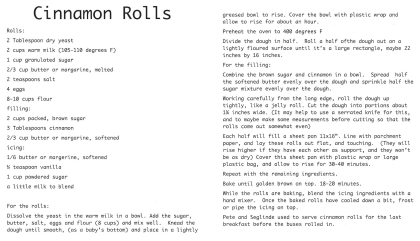
This month we wanted to share a beloved camp recipe with you and your family; Cinnamon Rolls! We hope that you’ll be able to bake these together and share them with those you love this holiday season.
1. Bernardi, Elisabetta, and Francesco Visioli. “Fostering Wellbeing and Healthy Lifestyles through Conviviality and Commensality: Underappreciated Benefits of the Mediterranean Diet.” Nutrition Research, vol. 126, 1 June 2024, pp. 46–57, https://doi.org/10.1016/j.nutres.2024.03.007.
2. Dunbar, R. I. M. “Breaking Bread: The Functions of Social Eating.” Adaptive Human Behavior and Physiology, vol. 3, no. 3, 2017, pp. 198–211, link.springer.com/article/10.1007/s40750-017-0061-4, https://doi.org/10.1007/s40750-017-0061-4.
3. Jönsson, Håkan, et al. “What Is Commensality? A Critical Discussion of an Expanding Research Field.” International Journal of Environmental Research and Public Health, vol. 18, no. 12, 9 June 2021, p. 6235, www.mdpi.com/1660-4601/18/12/6235, https://doi.org/10.3390/ijerph18126235.
4. “Shared Meals: A Predictor of Subjective Well-Being.” Center for Health & Well-Being, 2025, www.ie.edu/center-for-health-and-well-being/blog/shared-meals-a-predictor-of-subjective-well-being/.
5. UCL. “Sharing Mealtimes with Others Linked to Better Wellbeing.” UCL News, 20 Mar. 2025, www.ucl.ac.uk/news/2025/mar/sharing-mealtimes-others-linked-better-wellbeing.
6. “World Happiness Report 2025: People Are Much Kinder than We Expect, Research Shows | Saïd Business School.” Ox.ac.uk, 20 Mar. 2025, www.sbs.ox.ac.uk/news/world-happiness-report-2025-people-are-much-kinder-we-expect-research-shows.
Why Choose Farm Camp?
A Summer That Feeds the Soul
When families start searching for the right summer camp, the options can feel endless — sports camps, art camps, adventure camps, tech camps. But there’s only one Farm Camp, where childhood curiosity, community, and connection to nature come together in the most genuine way possible.
Since 1952, Farm Camp has offered something both timeless and rare: a traditional camp experience on a real working farm, nestled among 500 acres of redwoods, creeks, and rolling coastal foothills just a mile and a half from the Pacific Ocean. Here, children trade screens for sunshine, grow their confidence through hands-on work, and discover the joy of living in harmony with the natural world.
Freedom to Choose, Freedom to Grow
At Farm Camp, campers shape their own days through our free-choice program. Every morning, they decide how they want to spend their activity time — maybe washing the puppies, helping in the garden, swimming in the lake, hiking through redwoods, or crafting something beautiful at the Osprey House.
This freedom is intentional. It empowers campers to listen to themselves, make choices, and learn by doing. By choosing what excites them, they build independence, confidence, and a sense of ownership in their own experience — lessons that last far beyond summer.
A True Community of Care
Our camp runs on community, not just in spirit, but in practice. Everyone contributes to the rhythm of daily life, from feeding animals and washing dishes to sharing stories at the dinner table. These simple, shared tasks create a sense of belonging and remind campers that their effort matters.
We believe that community is the foundation of our lives, and that living, working, and playing together nurtures the soul. At Farm Camp, friendships form naturally through cooperation and laughter, and each camper becomes part of something larger than themselves.
Rooted in Our Core Values
Everything we do grows from a deep respect for nature, people, and the interconnectedness of all living things.
- Stewardship of the earth and our diverse community is at the heart of our mission.
- Nature is our greatest teacher — a source of inspiration, healing, and balance.
- Happiness and fun are not afterthoughts, but essential to well-being.
- Integrity, compassion, and respect guide the way we live and work together.
These values don’t just exist on paper, they shape every moment of camp life, from morning chores to evening campfires.
More Than a Summer — A Lifelong Foundation
Farm Camp isn’t just a place to spend a few weeks in the summer. It’s a place where children discover who they are, connect deeply with others, and find joy in simple, meaningful living.
They go home with more than stories of campfire skits and farm animals — they take with them confidence, gratitude, and a lifelong appreciation for the natural world.
At Farm Camp, we nurture not only campers, but the goodness of the human spirit. And that’s something that lasts a lifetime.
Nervcited! Starting the Camp Countdown Chat with Your Camper
If your child is attending camp for the first time they might be starting to feel butterflies in their tummy. What is it going to be like? Am I going to make friends? What if it’s scary? Will my counselors help me?
These are all completely understandable questions and we’d be surprised if your camper didn’t feel a little nervous for the experience. Simply by coming to camp your child is stepping out of their comfort zone and taking what feels like a risk. They don’t know what the outcome will be and therefore it feels new, exciting and possibly scary too.
However, we know that children who step out of their comfort zones and engage in healthy risks build greater resilience, confidence, decision-making skills and are more tolerant to stressful situations in the future (1).
As an article from the American Camp Association states, “Resilience is the answer to the doubts we have as parents. Won’t he miss me? What if she gets sick? Homesickness, bug bites, disappointments, and injuries all can be weathered without mom or dad. As the camp doctor at a fantastic overnight camp, I can tell you that kids do look for a parent in those moments. And then they surprise themselves as they turn to counselors, new friends, and their own inner strength to get through and get over the hardships. What pride and self-confidence they discover as they learn of their own resilience” (2). While we know that the outcomes can be great, the process isn’t always easy.
In order to best set new campers up for success it’s important to be open with them about what they may face in this very new environment. Yes, they will have a really great time and sometimes they might really miss home while they’re doing it. And yes, they will make friends, and they might occasionally have a disagreement/differing opinion with one of their unit mates. It’s okay to have these conflicting experiences at once – they are in a safe place to process it. Just because you have difficult moments or feelings that you don’t enjoy, doesn’t mean that the whole experience is bad or that you’re not brave enough to be there!
While at camp, your camper is surrounded by adults who genuinely care about them. Our staff have been trained in how to help when a camper feels homesick or is having conflict with another camper. They also make sure to celebrate the moments, big or small, when your camper has learned something new, gone on their first big hike, or gotten on stage to perform in the drama. If your camper is ever experiencing feelings that are difficult to process, we have a team of directors who will stay with your camper for as long as it takes to work through those emotions. Then we’ll make a plan on how to move forward. We’re always here and ready to help whenever your camper needs it.
We’ve found that campers who have talked through their anxieties, goals and hopes for camp before arriving are often better at processing those tough emotions independently when they arise. Reminding your camper that they’re brave even when they miss home, and that they’re strong enough to keep going is awesome. Similarly, a reminder that their counselors and the leadership team are here to support them whenever they need it is great too. Below we’ve listed some questions that might help start the conversation!
- What are you MOST excited for?
- What are you most nervous about?
- What do you think it’ll be like living in a cabin for a week or two (or four)?
- I know we’ll miss each other while you’re gone but I know you’re going to have so much fun. You’re brave and strong and we know that you can do it. What are some things that might help if you get a little sad while you’re there?
- Are you interested in making new friends? What are some ways you could do that?
- What would you do if there was someone who you don’t get along with?
- On the first night of camp there will be a campfire in your unit where everyone gets to talk about how to live together. Do you have any ideas on what rules you think might be helpful?
- Is there anything you want to be sure your counselor(s) know about you?
- Are there any new things you want to try? New food, skills, etc.
- What’s one thing you want to make sure to accomplish before you go home?
- Make sure you tell your counselor when you get there so that they can help you with that goal!
This is just a jumping off point as you and your camper consider what their camp experience might be like. Campers may have times where camp is a huge challenge for them, but often those are the moments where they’re growing the most. Ultimately, we hope that “learning respect, resilience, and responsibility at camp will establish each (camper) as a person who can achieve his or her dreams” (2). We’re proud of you and your camper for taking this leap and trying something new! We can’t wait to see you this summer!
- “Bright Horizons | Risk Taking in Early Childhood: When Is It Appropriate? | Bright Horizons?” Brighthorizons.com, Bright Horizons, 2024, www.brighthorizons.com/article/children/risk-taking-benefits-children.
- Gilboa, Deborah. “Imagine Respect, Inspire Resilience, Impact Responsibility.” American Camp Association, 29 Sept. 2015, www.acacamps.org/article/camping-magazine/imagine-respect-inspire-resilience-impact-responsibility.